Skymonsters
Astrophotography by Nicola Montecchiari
Tarantula Nebula
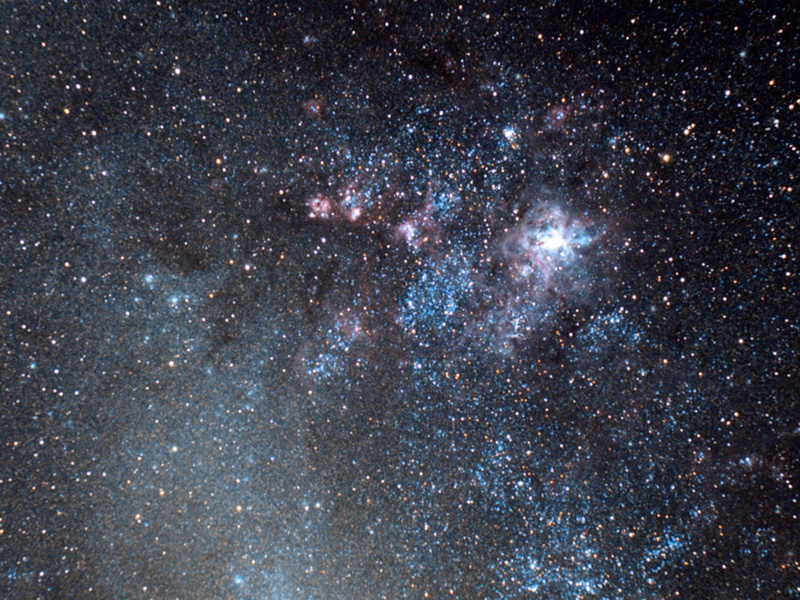
| Date/Place | 2007-05-15 at Farm Hakos, Namibia |
| Coordinates | AR 05h 38m 22s DEC -69° 17' 33" |
| Instrument | Skywatcher 80ED |
| Camera | Modified 350D |
| Integration | 45 minutes, 5 minutes per frame (RGB) |
| Description | The image frames one of the most spectacular and rich regions of the southern sky, located within the Large Magellanic Cloud (LMC), an irregular dwarf galaxy satellite of our Milky Way, visible in the constellation Dorado.
|
| Comment | This is my first attempt at this region, and I have to say it was a kind of tough. The object was very low in the southern sky on May so I have to start shooting it as soon as it gets dark. The region is unique as it gives the chance to look into another galaxy, the Grat Magellanic Cloud, which is supposed to orbit around the Milky Way. The Tarantula Nebula emission region has a very bright core and as you can see, it is not totally an emission nebula, but there is a fair amount of blue hue all around and inside of it. |