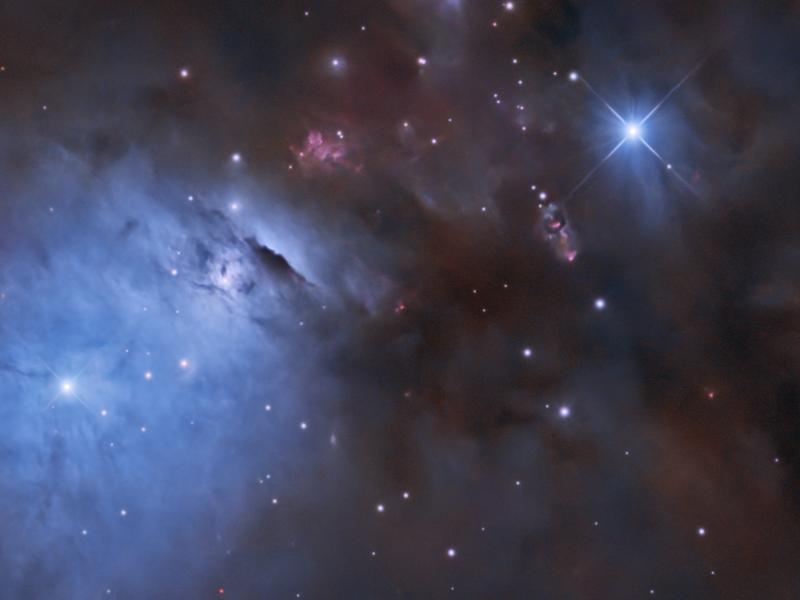
NGC1333
| Date/Place | 2024-12-20 at Elijah Observatory |
| Coordinates | AR 03h 29m 12s DEC +31° 18'42" |
| Instrument | GSO RC10 Truss |
| Camera | QSI583wsg |
| Integration | LRGB Composition |
| Comment | It is a celestial object of great astronomical interest, known for being a very active region of star formation. Primarily a Reflection Nebula (hence its characteristic bluish color), but it also includes dense Dark Nebulae and Emission Nebulosity regions (often reddish). Located in the northern constellation of Perseus, near the border with Taurus and Aries. It is part of the larger Perseus Molecular Cloud, one of the closest low-mass star-forming regions to the Solar System. It is estimated to be between 960 and 1,140 light-years from Earth (about 300–350 parsecs). It was discovered by the German astronomer Eduard Schönfeld in 1855. NGC 1333 is one of the most studied objects of its kind and is considered a true "stellar nursery". It hosts hundreds of stars with an average age of about one million years, an extremely short period in astronomical terms. It contains numerous Young Stellar Objects (YSOs) and protostars still embedded in the gas and dust from which they are forming. One of its most distinctive features is the presence of numerous Herbig-Haro objects (at least 45 have been counted). These are small, bright, reddish nebulosities created when jets of matter ejected by forming protostars collide with the surrounding gas at high speed. The large number of jets in this region suggests they may help disperse the gas cloud, limiting further star formation. In 2011, researchers also discovered a significant number of brown dwarfs in the cloud (around 30–40 objects). |