Skymonsters
Astrophotography by Nicola Montecchiari
NGC7129
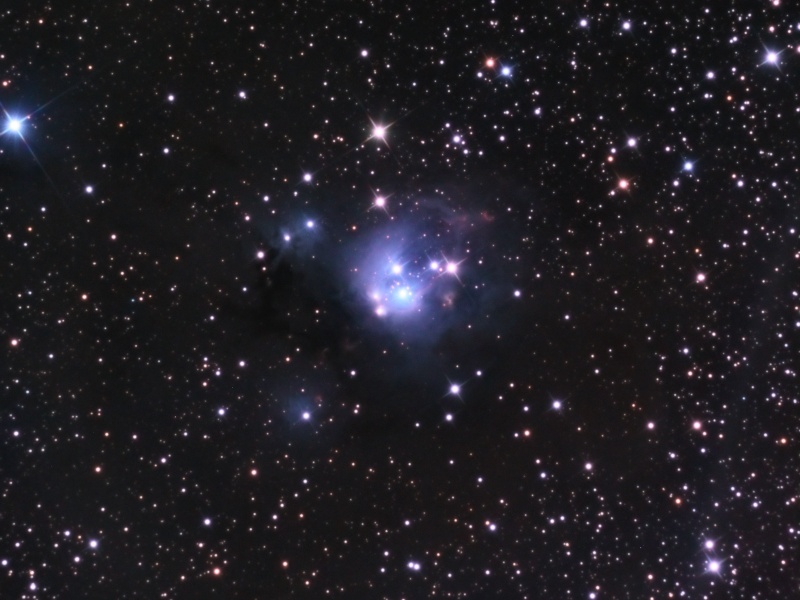
| Date/Place | 2025-09-06 at Elijah Observatory |
| Coordinates | AR 21h 43m 02s DEC 66° 07'22" |
| Instrument | GSO RC10 Truss |
| Camera | QSI583wsg |
| Integration | LRGBH Composition L: 77x600 sec. RGB: 30 x 600 sec. for each channel H-alpha: 55 x 1200 sec. |
| Comment | NGC7129 is a striking cosmic nursery located roughly 3,300 light-years away in the northern constellation of Cepheus. It is classified as a combination of a cosmic reflection nebula a cloud of dust that scatters and reflects the light of nearby stars and a young, tightly packed open star cluster. Key Features of NGC7129 The "Rosebud" Shape: Often nicknamed the Rosebud Nebula or Flower Bud Nebula, its unique shape is the result of astronomical cosmic mayhem. The young stars inside have blown an irregular, bubble-like cavity into the dense molecular cloud that originally enveloped them. A Stellar Nursery: The embedded open cluster contains more than 130 newborn stars, most of which are incredibly young in astronomical terms—less than 1 million years old. For comparison, our own Sun is about 4.6 billion years old. Supersonic Jet Action: Near the center of the nebula, several very young stars are blasting supersonic jets of gas out into the surrounding cloud. When these jets slam into the cooler molecular gas, they heat up elements like carbon monoxide and hydrogen. This interaction creates intricate cosmic structures, including bright, reddish crescent-shaped features known as Herbig-Haro objects, which visually look like the "stem" of the rosebud. Cosmic Reflections: In visible light telescope images, the nebula glows with a vibrant, dusty blue color because the dust grains are highly efficient at scattering blue light from the hot, young stars. When viewed in the infrared spectrum (by telescopes like NASA's Spitzer Space Telescope), the outer edges of the bubble glow with a deep pinkish-red hue as the intense ultraviolet starlight heats up hydrocarbon-rich dust grains. Astronomers closely study cosmic structures like NGC 7129 because it provides a snapshot of the intense, chaotic environments where stars are born. In fact, evidence suggests that billions of years ago, our own Sun likely began its life in a crowded stellar cluster very similar to this one. |